Building more capable innovation ecosystems - who is ready to help?
Across Australia, New Zealand and the wider Oceania region, we are increasingly relying on clusters and innovation ecosystems to help address complex challenges - from industry transition and productivity to decarbonisation, resilience and regional development.
But there is a gap we still do not talk about enough.
We invest in research infrastructure. We invest in innovation infrastructure. We invest in physical infrastructure.
Yet we invest far less systematically in the human and relational infrastructure that connects it all together.
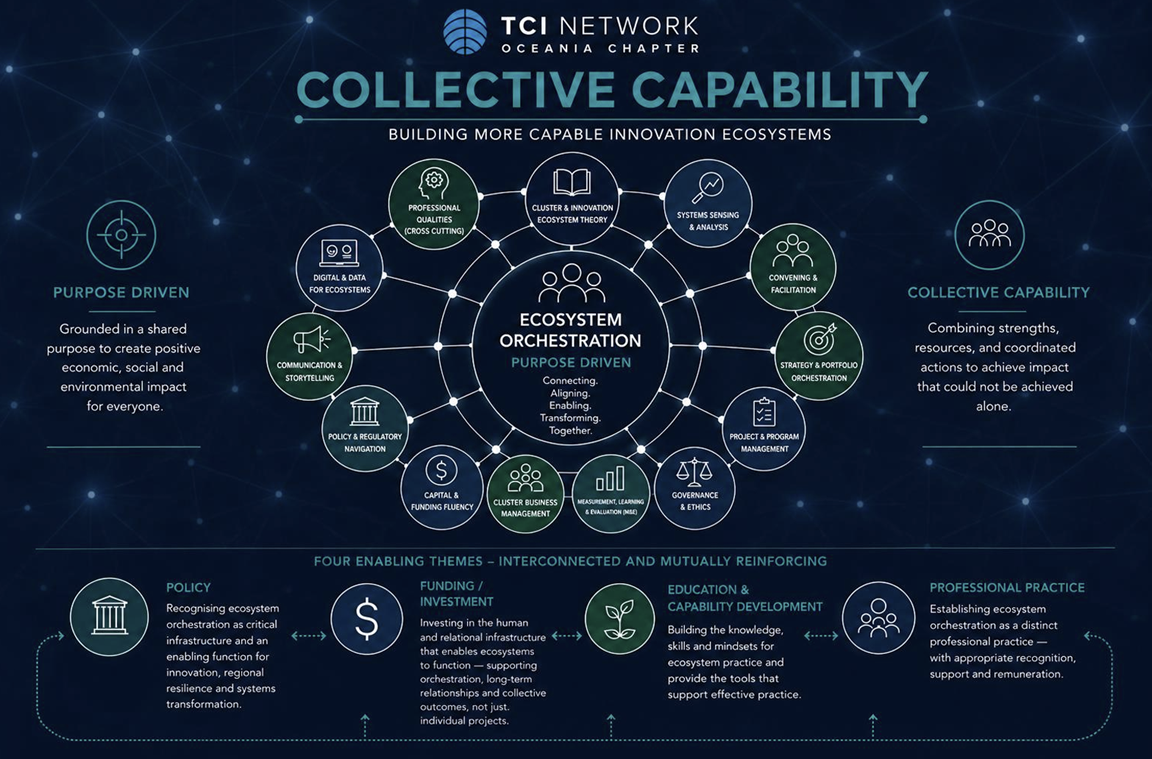
Following TCI Oceania’s recent webinar on building capability for cluster and innovation ecosystem practice, the conversation continued. Questions raised during and after the session - about what effective ecosystem practice actually requires, how those capabilities are developed, and where they should sit - helped prompt the development of a new TCI Oceania discussion paper, An Ongoing Conversation on Building More Capable Innovation Ecosystems.
The starting point was a relatively simple question: what capabilities are required to effectively lead, convene and orchestrate innovation ecosystems? But the conversation quickly moved beyond the capability of individual practitioners.
A healthy ecosystem itself needs to be capable - able to sense change, build shared understanding, mobilise resources, learn, adapt, innovate and coordinate action. Those capabilities are rarely held by one person or organisation. They emerge through the relationships between businesses, universities, government, investors, communities and practitioners.
That raises some practical questions for all of us.
Where are the universities prepared to embed ecosystem practice into their courses? Systems thinking, facilitation, adaptive leadership, ecosystem intelligence, governance, collective decision-making and orchestration increasingly sit alongside traditional technical and management skills. The paper argues that education and professional development will need to evolve accordingly.
There are also broader calls to action.
Governments and funders need to consider how orchestration, relationship-building and capability development are supported - not just individual projects;
Universities and training organisations can help build stronger learning pathways;
Practitioners need access to practical tools, mentoring and communities of practice. Industry and ecosystem organisations could help test whether the capability framework can be used diagnostically to identify strengths and gaps;
Researchers have an important role in understanding how ecosystem capability and impact should be measured; and
Digital innovators can help explore how AI, mapping, analytics and decision-support tools can strengthen ecosystem intelligence without replacing the trust, judgement and relationships on which collaboration depends.
The paper is deliberately not presented as a finished model. It is an invitation to challenge, refine, test and build on the ideas.
Nor are many of these ideas new. Practitioners, researchers and organisations working in clusters, systems change, regional development, collective impact and innovation ecosystems have been making similar observations for many years: relationships matter; orchestration matters; systems capability matters; and short-term projects alone do not build enduring ecosystems.
Perhaps the question now is less whether these capabilities matter, and more what we are going to do about developing and supporting them.
If innovation ecosystems are becoming critical infrastructure for economic and societal transformation, then it is time to invest deliberately in the people, capabilities and connective tissue that enable them to work.
That means moving from discussion towards practical experimentation.
Where are the universities prepared to integrate ecosystem practice into their courses? Who is prepared to test the capability framework within a real innovation ecosystem? Where are the funders willing to invest in orchestration and relational infrastructure alongside projects? And how might we build stronger learning pathways, communities of practice and professional recognition for the people doing this work?
If your university, organisation or network is interested in testing the framework, developing learning pathways, contributing tools or case studies, or helping take this conversation into practice, TCI Oceania would love to hear from you.